

Walter Kempowski Tadellöser Und Wolff Film
| Tadellöser & Wolff | |
|---|---|
| Directed past | Eberhard Fechner |
| Written past | Eberhard Fechner |
| Cinematography | Gero Erhardt |
| Edited past | Barbara Grimm |
| Production | Polyphon Film- und Fernsehgesellschaft |
| Distributed by | ZDF |
| Release appointment | 1975 |
| Running time | 192 |
| Country | Federal republic of germany |
| Language | German |
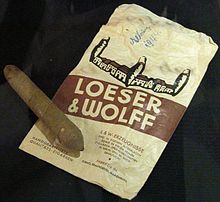
Paper handbag from the cigar visitor Loeser & Wolff with advertizement and a cigar. Handwritten note: "Elbing 1944".
Tadellöser & Wolff is a 1975 2-part television film which was produced for the German public-service Television receiver-broadcaster ZDF in Sepia. It is based on the 1971 book of the same name by Walter Kempowski. The kickoff broadcast took place on May 1 and three, 1975. The moving-picture show was a smashing success in Frg,
Plot [edit]
The film begins similar a documentary: Ernst Jacobi in the role of Walter Kempowski introduces the viewer to the activeness with family photos and pictures from Rostock. As a event, Jacobi occasionally comments on the picture show plot from offscreen.
The film portrays the life of the middle-form family unit Kempowski in Rostock from 1939 to 1945 in close item to the novel. In addition to describing the special events in the life of Walter and in the family, there are always depictions of everyday life, such as walks with the father through Rostock, in schoolhouse and youth grouping, with friends and swing music, with eating together and Christmas celebrations with the family, going to church or going to the cinema. Begetter Karl loves cigars from the visitor "Loeser & Wolff", which, when praised, always prompts him to say „tadellos, tadellöser, Tadellöser und Wolff" (translated: "impeccable, impeccable, impeccable and Wolff").
The story begins when the Kempowski family moves into a new apartment in Rostock on April sixteen, 1939. This is followed by a description of the situation in the new apartment and the events in the family, during a meal together, during a visit to the grandfather and at a scene with the neighbour'due south daughter.
During a dinner, Father Karl announces a vacation trip. The family travels to the Harz on Baronial 10, 1939, where they firm in an officers' dwelling. There they get the news of an impending war, whereupon they leave prematurely.
Presently after the family's return, the paternal grandfather died. Considering the estate, considerable debts are found, which now have to be repaid, so the family cannot move into the grandfather's villa, but rents it out. Walter gets sick on Christmas Day. The doctor diagnoses scarlet fever and speaks over a recovery period of six weeks.
Later Walter took piano lessons. The piano instructor is strict and Walter doesn't seem to have practiced enough. Nevertheless, in 1941 he played the piano at a Hitler Youth Christmas party in the Rostock City Theater.
So there is a heavy bomb attack on Rostock. Mother Grete is assigned as an air-raid alarm officer and sends the house residents downward to the basement. With the end of the bombings the apartment edifice is only slightly damaged, but some bombs accept striking in the street. Brother Robert, who was on the road as a responder in the city, tells his family about the reports on the considerable destruction in Rostock he had to brand, that the Selters-h2o-factory in the neighborhood burns down.
The Dane Sven Sörensen, an employee in the father's office, was arrested by the Gestapo for tracing successful bombings on a city map. Female parent Grete goes to the Gestapo to go him released. He was released shortly afterwards and moved into the Kempowski family unit'southward apartment because his own apartment was destroyed past the bombing.
When Male parent Karl, who is a first lieutenant in the Wehrmacht comes home during vacation from the front end, at that place are tensions in the family at beginning, which somewhen calm downwardly. Since Walter's achievements in school have deteriorated considerably, it is decided that he has to go to the very strict Anna Kröger, called Aunt Anna, to tutor.
Walter's sister Ulla and Sven Sörensen go married in May 1943. The racial laws exercise not pose any difficulties for the young couple, every bit Sven is "Northerner". The nuptials celebration, where many relatives nourish to, takes place in the Kempowski family'southward apartment and considering of the food that had to be brought from the black marketplace because of the war economic system
Ulla and Sven then move to Denmark. The family says goodbye to them at the train station on the train to Copenhagen. The family members remaining in Rostock are sad on the 1 hand about the goodbye, simply on the other hand likewise happy because Ulla is at present in a condom place.
During the school holidays in 1944, Walter spent three weeks at the estate Gut Germitz. This estate on Plauer See belongs to the family of Ferdinand von Germitz, whom he knew from tutoring at Anna Kröger. During his stay, he got to know Greta, Ferdinand's sister, better.
Male parent Karl came abode on vacation once more in October 1944. Due to the current war situation, the mood during his stay is already very sorry. At the end of his vacation, Walter and his mother say goodbye to the father at the train station. From there, he returns to his mail service in an uncertain future.
Since Mother Grete's father'due south business firm in Hamburg was destroyed past the bombing, he comes to Rostock. The grandad is admitted to the family home. A refugee, Frau Stoffel, has also been billeted.
On February 17, 1945, Walter was too drafted into the military. He works as a courier, and in mid-April 1945 on an assignment in Berlin, he realizes that the Russians (Ruby-red Army Soldiers) must have come up very close to the urban center. He looks for a way out of the city and so manages to notice a train to Rostock in Nauen (Brandenburg), with which he arrives in Rostock on Apr 25, 1945. The film ends with the scene on the May 1, 1945 (the day of the end of world war 2), where Walter sits on the balcony with his female parent and grandfather to encounter Russian soldiers for the beginning time, as they march into their street in Rostock.
Cast [edit]
- Edda Seippel equally Margarethe Kempowski
- Karl Lieffen as Karl Kempowski
- Michael Poliza every bit Walter Kempowski (als Jugendlicher)
- Martin Kollewe as Walter Kempowski (als Junge)
- Martin Semmelrogge as Robert Kempowski
- Gabriele Michel every bit Ulla Kempowski
- Jesper Christensen as Sven Sörensen
- Ernst Jacobi as Erzähler
- Ernst von Klipstein every bit Großvater de Bonsac
- Helga Feddersen equally Anna Kröger
- Gert Haucke equally Dr. Fink
- Marianne Kehlau
- Inge Landgut
Filming [edit]
The unabridged film was not shot in color, but Fechner deliberately chose sepia equally a stylistic device to give the film more authenticity. The shooting took place in October 1974 partly in Börßum (Lower Saxony), Lüneburg, Eckernförde and Hamburg-Harburg.
Movie Score [edit]
The basic musical theme of the film with the text "Years of Life; all in vain. When will nosotros meet each other again? ", was delivered within the outset movement of the 6th Symphony in B minor, op. 74, by Peter Tchaikovsky. In the course of the film, the jazz classic Georgia on My Mind by Hoagy Carmichael is played in several scenes.
Critics [edit]
- „The cast as well appears to be optimal: How Edda Seippel plays mother Kempowski's oppressively unsuspecting indestructibility, how she nags her notorious "No, how it is at present possible": how Martin Semmelrogge puts down the sekundaner'south elan of the son Robert; how Karl Lieffen, hither a disciplined comedian, lets the "birdy" father neat his jokes and in the terminate even imbues him with a trace of tragedy due to his alcohol, which becomes less tired under the war experience - "prime"! "[i]
- „ A movie is shown - the director: better not imaginable; the actors: accomplishing the feat of showing individuals who are exemplary - people who, unmistakable in their independence, even so function equally character masks - a film that, in the past, also means the present. The perfect, show Kempowski and Fechner, is an imperfect. The activity is still ongoing. The K. family has non changed in its structure. The film's leitmotifs point beyond the piece and prove that information technology tin can be repeated at whatever fourth dimension. The social-Darwinian pattern of thought of this family unit remains dominant."[2]
Sequel [edit]
In 1979, as well nether Fechner'southward direction, the three-part continuation of the Kempowskian family history appeared nether the title "Ein Kapitel für sich" (A chapter for itself).
References [edit]
- ^ Becker, Rolf (27 April 1975). "FERNSEHEN : Tadellos, primig - DER SPIEGEL 18/1975". Der Spiegel . Retrieved 2020-01-14 .
- ^ ZEIT (Archiv), D. I. East. (1975-05-09). "Von Folter und Verbrennung keine Rede". Die Zeit (in German). ISSN 0044-2070. Retrieved 2020-01-xiv .
Source: https://en.wikipedia.org/wiki/Tadell%C3%B6ser_%26_Wolff
Posted by: littlelicureaund.blogspot.com
0 Response to "Walter Kempowski Tadellöser Und Wolff Film"
Post a Comment